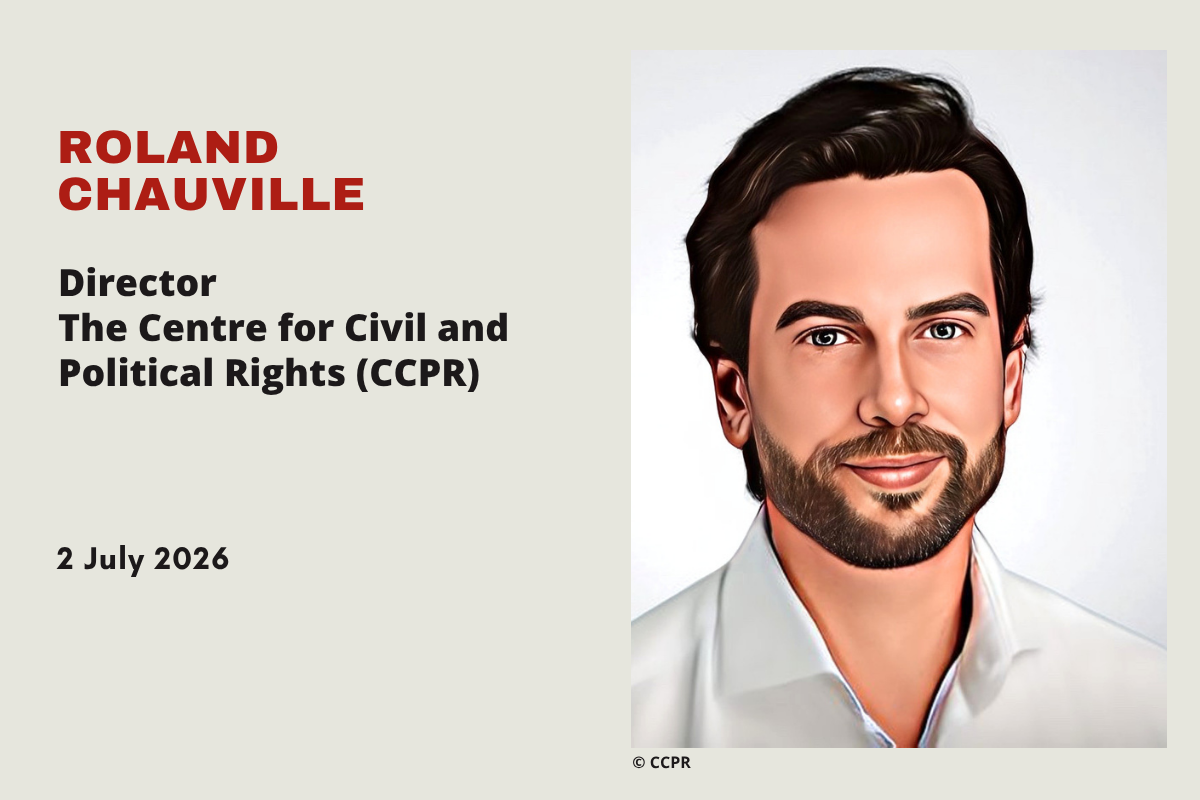
The Interview | Roland Chauville

 |
|
I am most proud of the expertise that the Centre for Civil and Political Rights (CCPR Centre) has developed in supporting non-governmental organisations (NGOs) and human rights defenders. We help them access United Nations (UN) human rights programmes and mechanisms, such as the Human Rights Committee (HR Committee). This human rights architecture can be complex to understand and engage with. Over its 18 years of existence, the Centre has honed a real skill: making UN engagement easier for local actors. We’ve also established a strong relationship with the HR Committee. This group of 18 independent experts reviews how States respect and implement the International Covenant on Civil and Political Rights. This close tie means that the CCPR Centre has more impact and relevance. We play a niche role in the Geneva human rights ecosystem.
In terms of impact, as a direct result of the Centre’s work, the HR Committee has adopted an innovative and quite unique follow-up procedure which includes a grading system (A-E) used to assess State compliance with priority recommendations. The Centre was instrumental in designing and promoting this system, which now provides a structured framework for accountability. Over the last 15 years, over 1’000 recommendations made to over 90 countries have been graded by the HR Committee: about 45% of them have led to meaningful impact in countries. The Centre has also institutionalised the practice of organizing follow-up visits to countries with HR Committee members.
 |
|
Having all the UN human rights programmes and agencies in one city allows us to easily access UN staff, states representatives, NGOs, and experts, facilitating connections and collaboration. The human rights community is strongest when it comes together, and this concentration of actors in a relatively small space fosters cooperation. This level of accessibility and density is unique worldwide. It leads to stronger information flows and better and more effective synergies.
 |
|
I constantly question what we do and how we do it, always keeping in mind the human rights defenders we serve at the national level. I am also curious about other organisations – how they operate, what they achieve – and I try to stay informed about major global trends. I have a strong drive to explore new approaches, with the aim of making the CCPR Centre more effective in improving access to UN human rights mechanisms. Adaptability is key when working in a (relatively) small NGO especially given the evolving global context and funding landscape. We therefore need to continuously reinvent ourselves.
 |
|
The develop of AI is profoundly transforming our societies – how we can interact as humans and how we work - and its impact will be felt for years to come. At the same time, I am deeply concerned about its implication for civil and political rights, particularly regarding freedom of expression and the right to vote. We need to both embrace certain aspect of AI and work collectively to mitigate its risks to human rights. Navigating this tension will be essential as we seek to understand and adapt to its rapid evolution.
I was also inspired by the creating of the Fondation pour l’Adaptation de la Genève Internationale. This private-public funding initiative is very timely and has strong potential to help NGOs adapt to the ongoing changes I mentioned.
Finally, 2026 marks the 60th anniversary of the International Covenant on Civil and Political Rights (ICCPR), a seminal document in the field of human rights. We’re very excited to announce an exhibition on Quai Wilson in July, which will explore the history and evolution of the Covenant, as well as its most significant articles. These will be illustrated through editorial cartoons, as part of a partnership with Cartooning for Peace. The exhibition is notably supported by the Canton and Ville de Genève and will be developed into a publication.
This anniversary comes at a pivotal moment in contemporary history, marked by a concerning erosion of human rights worldwide. In the face of this multifaceted crisis of civil and political rights, the commemoration of the ICCPR takes on particular significance: it recalls the international community’s solemn commitment to respect and protect these inalienable rights, reaffirms their universal and indivisible nature, and underscores the essential role of international protection mechanisms based in Geneva.
 |
|
Open, supportive, resilient.
Roland Chauville's biography
Learn more about CCPR
 | See the exhibition on Quai WilsonPublication "60th anniversary of the International Covenant on Civil and Political Rights" |
|---|